This week has been busy, so I have not developed my design as far as I would have liked, however, with the coming week, I endeavour to catch up.
I have two main concepts for the building:
1) That the new structure would relate to and have a relationship to the existing structure of the Story Bridge
2) That the new architecture as a whole, might be interactive, or have interactive elements within the fabric of the building
I have begun sketching ideas of form, spatial arrangment and massing studies, which I will upload in future posts (hopefully I will remember!). However I have begun to explore how the structure could be suspended and interconnected to the under side of the bridge.
I realised that there will need to be accessed from the ground level of the wharves to the suspended 'pod', as access from the bridge is not viable due to traffic, and from the cliffs is possible though not as advantageous as from the wharves.
I began to realise that part of the building will need to rest on the ground, because physically suspending the entire mass off the bridge may not be feasible. Similarly, as access must be from the ground, I would prefer there to be more than just a lift shaft and goods hoist on ground level.
In terms of my two initial concepts for the design, I have so far explored how the two structures of bridge and entertainment venue can be structurally linked, and now I move on to looking at how my building can beome interactive. In order to do this I need to look at the Story Bridge and how it interacts with people, and then I may be able to apply similar principles to my structure, seeing as the two are linked. (For example, the bridge structure creates and resonates with varying frequencies and strains from use and either blocks or echoes environmental sounds - similarly my building could utilise technology to provide a similar relationship - recording and echoing environmental sounds into some form of music track, amplifying/carrying the strains of the bridge, or simply creating a structure which will generate sound, similar to the bridge.)
Wednesday, March 31, 2010

Wednesday, March 24, 2010
Exemplar Research
Week 5, Sem 1, 2010
Included below is a list of some of the more interesting examples of interactive, moving or just unusual architecture I have found.
1) http://www.essential-architecture.com/IMAGES2/twistsandturns.jpg
This looks like a shifting/warping light and shadows pattern on the illuminated building façade, making the building structure appear to be warping.
2) http://www.interactivearchitecture.org/nox-son-o-house.html
Written about the structure, from the website - "The structure is both an architectural and a sound installation that allows people to not just hear sound in a musical structure, but also to participate in the composition of the sound. It is an instrument, score and studio at the same time.A sound work, made by composer Edwin van der Heide, is continuously generating new sound patterns activated by sensors picking up actual movements of visitors."
3) http://www.nada.kth.se/~asa/ray.html
I’m thinking of having my structure suspended underneath the Story Bridge so this was a look into some ideas of suspended structures.
4) http://weburbanist.com/wp-content/uploads/2008/07/moving-building-art.jpg
We saw this in a lecture last year - the rotating section of wall – hydraulic/mechanical
5)http://weburbanist.com/wp-content/uploads/2009/10/Moving01.jpg
Actual water or just a projection/fabric?
6) Youtube video - http://www.youtube.com/watch?v=D4sZ1aETAyU
Chameleon Chair Video – YoutubeChairs change colour to the same as the clothes touching them. It's more fun to watch these interactive technologies than look at still images!
7) http://www.youtube.com/watch?v=ushJnQfjbF0&feature=related
Interactive mirrors (wooden tiles, pegs, woven material in this example).
Camera captures a monotone/greyscale image – pixelated and mirror/reproduce/copy what is going on in front.
8) Ned Kahn does a lot of interesting façade work, looking at articulating natural elements, particularly the wind but also cloud and water, by creating a physical movement in the façade to express the natural force.
http://www.youtube.com/watch?v=nvkNdlKVP2Y
9) MY TRIP TO NEW ZEALAND
http://tepapa.files.wordpress.com/2009/09/architecture3.jpg
This was part of a really good exhibition at TePapa Museum (New Zealand’s national museum) in Wellington. The exhibit was called “Interactive Architecture” and I went and had a look while I was in New Zealand on the summer holidays. This particular exhibit pictured involved the interaction of this umbrella wall to light and shade. A projector shone on the umbrellas and changed so that when the umbrellas were in shadow, they would close like flowers, and then open when in light like a flower blooming. It was made more interesting still by the ability of visitors to the museum to walk in front and create their own shadows, and hence close the umrbellas.
There was a similar exhibit which involved a cluster of ‘urchin’ like mechanisms suspended from the ceiling which worked by motion sensors. When you walked under them, they suctioned closed individually and when you were gone, gradually opened up again.
That's all for now! Next step is developing my specific brief!
Included below is a list of some of the more interesting examples of interactive, moving or just unusual architecture I have found.
1) http://www.essential-architecture.com/IMAGES2/twistsandturns.jpg

This looks like a shifting/warping light and shadows pattern on the illuminated building façade, making the building structure appear to be warping.
2) http://www.interactivearchitecture.org/nox-son-o-house.html
Written about the structure, from the website - "The structure is both an architectural and a sound installation that allows people to not just hear sound in a musical structure, but also to participate in the composition of the sound. It is an instrument, score and studio at the same time.A sound work, made by composer Edwin van der Heide, is continuously generating new sound patterns activated by sensors picking up actual movements of visitors."
3) http://www.nada.kth.se/~asa/ray.html
I’m thinking of having my structure suspended underneath the Story Bridge so this was a look into some ideas of suspended structures.
4) http://weburbanist.com/wp-content/uploads/2008/07/moving-building-art.jpg
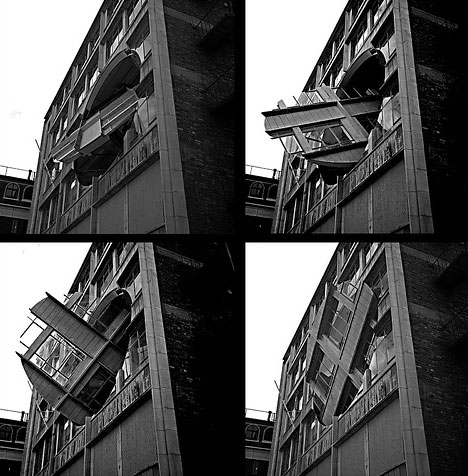
We saw this in a lecture last year - the rotating section of wall – hydraulic/mechanical
5)http://weburbanist.com/wp-content/uploads/2009/10/Moving01.jpg
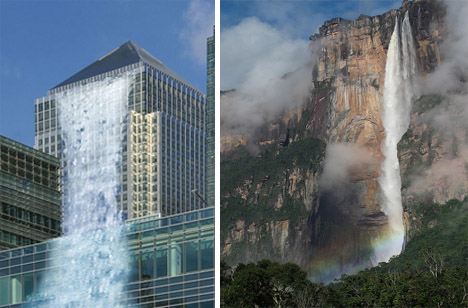
Actual water or just a projection/fabric?
6) Youtube video - http://www.youtube.com/watch?v=D4sZ1aETAyU
Chameleon Chair Video – YoutubeChairs change colour to the same as the clothes touching them. It's more fun to watch these interactive technologies than look at still images!
7) http://www.youtube.com/watch?v=ushJnQfjbF0&feature=related
Interactive mirrors (wooden tiles, pegs, woven material in this example).
Camera captures a monotone/greyscale image – pixelated and mirror/reproduce/copy what is going on in front.
8) Ned Kahn does a lot of interesting façade work, looking at articulating natural elements, particularly the wind but also cloud and water, by creating a physical movement in the façade to express the natural force.
http://www.youtube.com/watch?v=nvkNdlKVP2Y
9) MY TRIP TO NEW ZEALAND
http://tepapa.files.wordpress.com/2009/09/architecture3.jpg

This was part of a really good exhibition at TePapa Museum (New Zealand’s national museum) in Wellington. The exhibit was called “Interactive Architecture” and I went and had a look while I was in New Zealand on the summer holidays. This particular exhibit pictured involved the interaction of this umbrella wall to light and shade. A projector shone on the umbrellas and changed so that when the umbrellas were in shadow, they would close like flowers, and then open when in light like a flower blooming. It was made more interesting still by the ability of visitors to the museum to walk in front and create their own shadows, and hence close the umrbellas.
There was a similar exhibit which involved a cluster of ‘urchin’ like mechanisms suspended from the ceiling which worked by motion sensors. When you walked under them, they suctioned closed individually and when you were gone, gradually opened up again.
That's all for now! Next step is developing my specific brief!
Subscribe to:
Comments (Atom)