Wednesday, May 19, 2010

Theatre interior development

Theatre interior development

Looking at the floor space - which is similar to a contour map - the contours continue down. The lowest points in the floor (shown as the black pits in the renders below) are reinforced structural glass, so they can be stood on, yet they are transparent and you can see through to the river below.


The walls/external structure of the building has become a organic form (though still with softened angles like the story bridge).
These sketches are yet to be uploaded.

Sunday, May 16, 2010

External surface resolution

Resolving the external surface of the suspended building.

Option 1


Here, the abstracted lines become more dense at one end and open up at the other end. This allows more permeability and visibility at the theatre end (note: theatres are spheres not the cylinders shown - they simply mark the floor plan)
The open sections of the surface are digital glass whereby imagery can be projected through the surface (they become illuminated and only partially see through) however they can be turned back to just glass and be transparent as shown).

Option 2


Opposite to the above option. This uses the same principles of having the angled lines focussed at one end.

This option would be in reverse to the first option above as the denser end of the design and hence the area with more permeability should be overlaid over the theatre end of the building to give more dominance to it.

This option could be intergrated with the first to alternate from day-night depending on which space (restaurant or theatre) is being used the most.


Option 3

This is different from the previous two, whereby each section in between the diagonal slashes are raised/pop out from the main building. This gives focus to the negative space - i.e. the spaces in between the struts of the bridge or the slashes on the facade. I also considered that it could be an abstraction of a model of the city, with streets running in between the various blocks and buildings. By making one end of the facade more raised than the other, it appears like a map of the valley/city boundary, with medium rise buildings progressing into high rise/density.
It also provides a texture/scale-like geometry to the facade. Of course, digital glass could be applied to the individual 'scales' or 'blocks' to allow transparency or project onto, thus leaving the slashes solid. Alternatively, the digital glass could be applied to the slashes (they become like windows for the people inside) and the scales or blocks remain solid.


Wednesday, May 12, 2010

Preliminary 3D theatre model

I have been working on this model in 3DS Max, modelling the theatre spaces. At this stage, I have been concentrating on the exterior of the domes - the internal immersive environment will be modelled with a simple hemisphere and I will photoshop various panoramic images on the internal surface in a series of vignettes to depict the experience of the theatre-user. However this external waiting space is very important to the experience and hence these renders below begin to describe the spatial qualities more elegantly than the physical model.


Theatre domes interconnected (incomplete). Steps will eventually circumvent all domes.


Cluster of domes - internally a progression from one to the next takes place.


Approaching the domes from roughly a person's point of view.

Theatre dome massing studies

A couple of massing studies done in Revit, looking at the volume and interconnectivity of the theatre domes. I am interested particularly in the intersection between the individual domes.


Interior space development

After much sketch development and exploration, I have made some rough card models to explore the spatial qualities of the exterior of the theatre space - ie. the room in which people wait before entering the domes/theatres, which sit like dark, ominous barrows, buried beneath the illuminated contours surrounding them. In deed there is almost an ethereal quality to the illuminated domes. The spatial qualities of this 'preparation/waiting area' and the audience's awareness of their impending decent under the domes for the performance to begin, creates an anticipation and the forms help to heighten the excitement.


Sunday, April 18, 2010

Wharf building development

Below are some sketches from my development of the wharf building form. The key considerations which I developed as I went along were maintaining a clear axis slashed through the centre of the building which is angled towards the New Farm river branch. Also, a physical constraint was that part of the building had to fit through the archway of the Story bridge.


Further sketchup modelling: (Having transparent glass facade along axis - at night light will leak from axis and front (river and/or wharf walkway) facades of the building.

Lighting up the streetscape

http://www.architecturesdesign.com/wp-content/uploads/architecture-design/2009/07/Architecture-Building-Matchboxe-7.jpg

A vibrant example of a building contributing to the streetscape at night time and particularly allowing permiability and connection with the street level - people are able to see into the 'match boxes'. Interesting concept for the design as well.

Sketches 2

Concept sketches

Section depicting two buildings linked by slanting elevator under archway.
Looked at the possibility of having each building address one branch of the river, as the site sits at this sharp bend/axis of the river.


Starting to look at skewing the plan of a building to address the river or achieve an axis. Also started to consider roof forms which acknowledge form of bridge, as well as either opening up to the desired view or closing down to the other branch of the river.


Roof form exploration continued.


Sketch up concepts 2


One of the images from some massing tests done in sketch up - showing suspended building under bridge. Boundary of building to remain under edges of bridge.
Looked at size/scale of building and with introduction of wharf building mass underneath, and the elevator connecting the two.

Sketch up concepts 1


Massing test on 'Wharf building' (i.e. resting on the ground). Angled 'slash' through building to allow views/connection to river. Addresses only New Farm branch of river, not looking back to the city.


Along the axis.

View from the river, perpendicular (cannot see past building).


Approach from New Farm side of the river - can see down axis.


Saturday, April 17, 2010

Bubble Diagram


An exploration and clarification of spatial arrangments and relationships withing the buildings. The thicker the joining lines are, the more important/crucial the connection is.
Size of the bubbles roughly represents heirachy/importance and comparitive size of space/room.

Sketches

Some of my earliest sketches involved an exploration into site location and massing, and the possibilities for arrangement if I was to have a suspended pod. I had decided early on that I needed a pavillion located on the ground for access and services. This first sketch is one from a series which looked at massing and restriction of flow through the wharves.
I then moved onto looking at structural integration with the bridge. At first this was a very direct and literal concept - by sketching the frame/structure of the suspended pod as taking the angle of the bridge and being encased by steel beams. I liked the notion that the structure could become like a rib cage or skeleton however, this approach was a little too literal and copied the bridge too closely. I am currently making the connection more subtle.


Wednesday, April 14, 2010

Final week of sketch design

Thursday 15/04/10 (after design tute even though blog says Wednesday!)

One week to go until the sketch design presentations. My progress up to date includes a lot of diagrams, sketches, plans, sections, analytical diagrams and exemplar research. All of these drawings are compiled in my sketch journal which I will soon scan, and upload the key sketches from it.


However, over the past few weeks I have developed the general form and arrangement of my 'theatre'. I have also explored various interactive opportunities inside and outside the structure itself. To describe it for the moment without the help of diagrams - my scheme was to have a suspended theatre (with restaurant, bar, gallery, ticketing facilities) however, due to servicing and also access requirements and practicalities, I decided that some part of the centre/facility needed to be located on the ground level of the wharves. And so I have two wings/parts to my theatre which are one pavillion on the ground between the archway, and the other suspended from the bridge, on the river side of the arch. A slanting elevator (see image below of the eiffel tower elevator):


Source: http://www.tourblaze.com/parisfiles/EiffelTowerElevator_beggs.jpg

will connect the two pavillions.

The reason for the slanting elevator is the same as the reason for the angle in the structure/design of the suspended pavillion - it follows and incorporates into the structure and angles of the story bridge.

This morning after the design tute, the things which I will continue to develop and reason out are:
- finalising and prioritising the planning (i.e. ensuring heirachy of spaces is reflected in plans with important spaces getting larger areas and prominant placement)
-creating a subtle connection between bridge and pavillion - physically they are connected but making the architectural connection more sublte (i.e up until now, the pavillion was suspended with angles steel beams which were incorporated into the structure of the pavillion but this appears a mimic of the bridge's structure and so I need to find a balance between a subtle gap as if the pavillion is floating and also linking in some way to the bridge - which I will maintain by keeping the angles in the design, whether it be in the cladding, edges of the form or some other element.)
- Though the suspended pavillion was more organic and the ground pavillion more rectangulinear, I must ensure they are still obviously related/share some basic similarities whether they be organisationally, or materials or by form. It is to be one piece of architecture.

The sketches I am currently working on are finalising the form of each pavillion and hence finalising the floor plans. Uploaded sketches coming soon!

More inspiration

Mirror to look as though room continues - theatre could be completely empty and black and digital projections expand the space infinitely.
This image is of infinity on the gold coast.
Furthermore, I looked into having two buildings - one based on the ground for servicing purposes and the main entry (access purposes) while the other is suspended from the bridge and is connected to the ground building by an elevator. However this elevator, in keeping with the structure of the buildings and bridge will be at an angle (story bridge beams). I researched the elevators in the eiffel tower which run on a slant.
I have done a lot of sketch design work playing with the form of the building and also the spatial arrangment inside each building. Floor plans are being finalised at present. Hopefully will upload some diagrams soon when they are scanned in!

Wednesday, March 31, 2010

Initial and schematic design

This week has been busy, so I have not developed my design as far as I would have liked, however, with the coming week, I endeavour to catch up.

I have two main concepts for the building:
1) That the new structure would relate to and have a relationship to the existing structure of the Story Bridge
2) That the new architecture as a whole, might be interactive, or have interactive elements within the fabric of the building

I have begun sketching ideas of form, spatial arrangment and massing studies, which I will upload in future posts (hopefully I will remember!). However I have begun to explore how the structure could be suspended and interconnected to the under side of the bridge.
I realised that there will need to be accessed from the ground level of the wharves to the suspended 'pod', as access from the bridge is not viable due to traffic, and from the cliffs is possible though not as advantageous as from the wharves.

I began to realise that part of the building will need to rest on the ground, because physically suspending the entire mass off the bridge may not be feasible. Similarly, as access must be from the ground, I would prefer there to be more than just a lift shaft and goods hoist on ground level.

In terms of my two initial concepts for the design, I have so far explored how the two structures of bridge and entertainment venue can be structurally linked, and now I move on to looking at how my building can beome interactive. In order to do this I need to look at the Story Bridge and how it interacts with people, and then I may be able to apply similar principles to my structure, seeing as the two are linked. (For example, the bridge structure creates and resonates with varying frequencies and strains from use and either blocks or echoes environmental sounds - similarly my building could utilise technology to provide a similar relationship - recording and echoing environmental sounds into some form of music track, amplifying/carrying the strains of the bridge, or simply creating a structure which will generate sound, similar to the bridge.)

Wednesday, March 24, 2010

Exemplar Research

Week 5, Sem 1, 2010

Included below is a list of some of the more interesting examples of interactive, moving or just unusual architecture I have found.

1) http://www.essential-architecture.com/IMAGES2/twistsandturns.jpg
This looks like a shifting/warping light and shadows pattern on the illuminated building façade, making the building structure appear to be warping.

2) http://www.interactivearchitecture.org/nox-son-o-house.html
Written about the structure, from the website - "The structure is both an architectural and a sound installation that allows people to not just hear sound in a musical structure, but also to participate in the composition of the sound. It is an instrument, score and studio at the same time.A sound work, made by composer Edwin van der Heide, is continuously generating new sound patterns activated by sensors picking up actual movements of visitors."

3) http://www.nada.kth.se/~asa/ray.html
I’m thinking of having my structure suspended underneath the Story Bridge so this was a look into some ideas of suspended structures.

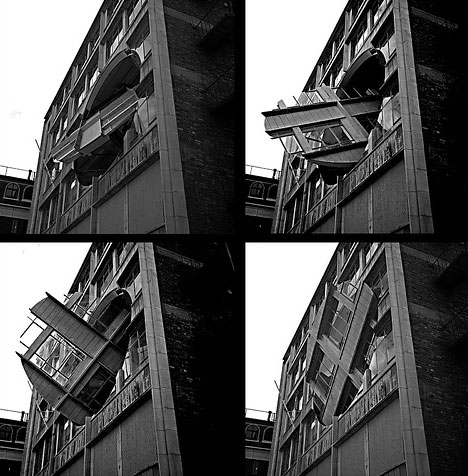
4) http://weburbanist.com/wp-content/uploads/2008/07/moving-building-art.jpg
We saw this in a lecture last year - the rotating section of wall – hydraulic/mechanical

5)http://weburbanist.com/wp-content/uploads/2009/10/Moving01.jpg
Actual water or just a projection/fabric?

6) Youtube video - http://www.youtube.com/watch?v=D4sZ1aETAyU
Chameleon Chair Video – YoutubeChairs change colour to the same as the clothes touching them. It's more fun to watch these interactive technologies than look at still images!


7) http://www.youtube.com/watch?v=ushJnQfjbF0&feature=related
Interactive mirrors (wooden tiles, pegs, woven material in this example).
Camera captures a monotone/greyscale image – pixelated and mirror/reproduce/copy what is going on in front.
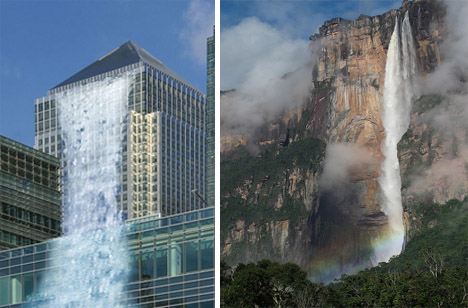

8) Ned Kahn does a lot of interesting façade work, looking at articulating natural elements, particularly the wind but also cloud and water, by creating a physical movement in the façade to express the natural force.
http://www.youtube.com/watch?v=nvkNdlKVP2Y


9) MY TRIP TO NEW ZEALAND
http://tepapa.files.wordpress.com/2009/09/architecture3.jpg
This was part of a really good exhibition at TePapa Museum (New Zealand’s national museum) in Wellington. The exhibit was called “Interactive Architecture” and I went and had a look while I was in New Zealand on the summer holidays. This particular exhibit pictured involved the interaction of this umbrella wall to light and shade. A projector shone on the umbrellas and changed so that when the umbrellas were in shadow, they would close like flowers, and then open when in light like a flower blooming. It was made more interesting still by the ability of visitors to the museum to walk in front and create their own shadows, and hence close the umrbellas.

There was a similar exhibit which involved a cluster of ‘urchin’ like mechanisms suspended from the ceiling which worked by motion sensors. When you walked under them, they suctioned closed individually and when you were gone, gradually opened up again.

That's all for now! Next step is developing my specific brief!